Fast Cornering Mastery

Declan Kennedy
| 20-09-2026
 · Auto Team
Fast cornering is a coordinated driving skill built around timing, positioning, and control.
Rather than relying on maximum entry speed, the driver must establish the right approach, follow an efficient line, and manage the transition from braking to acceleration.
A corner can be understood through five connected phases: approach, braking, turn-in, apex, and exit. Learning the purpose of each phase provides a structured foundation for improving performance on a closed circuit.
Read the Corner
Preparation begins before the steering wheel is turned. Identify the corner's direction, radius, turn-in point, apex, and exit. Fixed features such as braking markers, curbing, surface changes, and trackside references can provide useful visual points for repeatable positioning.
How front-end aerodynamics, airflow control, and ground clearance shape sports-car design
How rear wings generate aerodynamic load, refine vehicle balance, and influence high-speed performance
Light controls, automatic transmissions, and clever design make scooters feel effortless!
How engine, exhaust, tires, aerodynamics, and cabin design shape a sports car's sound
How wheel and tire dimensions shape handling, comfort, efficiency, wet-road traction, and fitment
A professional guide to preparing your vehicle for heat, sand, dust, and remote terrain
Early observation gives the driver a clear plan for the entire turn.
Establish Entry Speed
Braking determines the speed at which the car reaches turn-in. Apply pressure progressively while the vehicle is relatively straight, then release it smoothly as steering input increases.
Trail braking is an advanced technique that carries braking into the opening portion of the turn before progressively releasing the pedal. This changes the distribution of load across the tires and can influence vehicle balance, requiring refined control.
The appropriate entry speed depends on the corner geometry, vehicle characteristics, tire grip, and intended line.
Turn In Smoothly
At the selected turn-in point, introduce steering progressively and guide the car toward the apex. The steering input should match the intended trajectory rather than relying on frequent corrections.
If the car does not reach the desired path, reassess the entry speed, turn-in position, and initial steering angle before making further adjustments.
Position the Apex
The apex is the point where the driving line approaches the inside of the corner. Its position should reflect both the shape of the turn and the exit that follows.
A later apex can be advantageous when the corner opens onto a long acceleration zone, as it may provide a straighter path toward the exit.
The ideal apex is therefore determined by the efficiency of the complete line rather than its position alone.
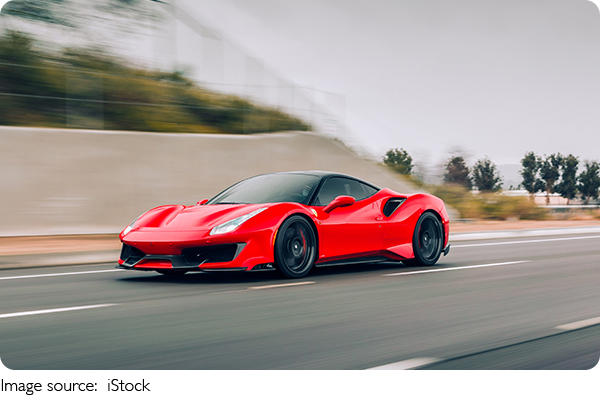
Direct Your Vision
Effective vision moves progressively through the corner. During the approach, identify the turn-in and apex. As the car reaches the middle of the turn, shift attention toward the exit.
This forward focus helps the driver anticipate the next section and prepare steering and pedal inputs with better timing.
Transition to Acceleration
As the car passes the apex, begin reducing steering angle as the corner opens. Throttle can then be increased progressively.
When steering demand decreases, a greater portion of available tire grip can generally contribute to acceleration. Throttle timing should reflect the corner's radius, surface, vehicle response, and available grip.
A smooth transition preserves the intended exit path while building speed.
Prioritize Exit Performance
Entry speed should be judged by its effect on the entire corner. A modest reduction in entry speed can produce a stronger result if it allows an earlier and cleaner acceleration phase.
This becomes particularly important when the turn leads onto a long straight, where exit speed directly influences the following acceleration zone.
Adapt to Vehicle Characteristics
Sports cars differ in weight distribution, suspension behavior, tire characteristics, braking response, and electronic systems. These factors affect how the vehicle reacts to steering, braking, and throttle inputs.
Understanding the car's responses allows the driver to adjust technique according to the demands of each corner rather than applying one fixed approach.
Refine Through Practice
Once the basic sequence is established, refine individual elements systematically. Work on braking references, turn-in accuracy, apex placement, visual timing, and throttle progression.
Changing one variable at a time makes improvements easier to identify and helps develop a repeatable technique.
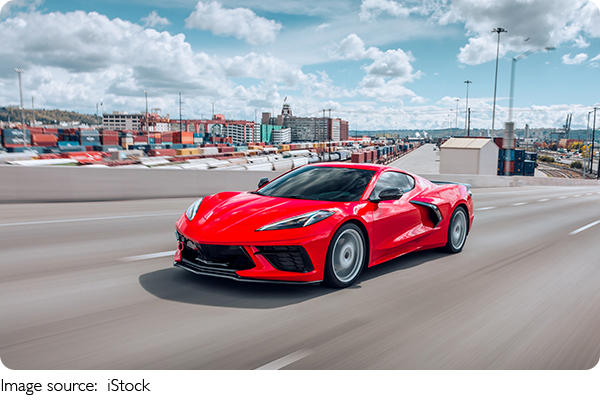
Fast cornering depends on the interaction of every phase of the turn. The driver reads the corner, establishes the appropriate entry speed, turns toward the selected apex, shifts vision toward the exit, and progressively builds acceleration.
The result is not simply greater speed, but a cleaner and more efficient driving line achieved through precise timing, measured inputs, and a clear understanding of the car's behavior.