Smarter Intersection Driving

Chandan Singh
| 28-09-2026
 · Auto Team
Uncontrolled intersections can be difficult for automated vehicles because there may be no traffic signals or clear priority rules to guide movement. The challenge becomes greater when buildings, roadside objects or other obstacles block part of the vehicle’s view.
A 2026 study published in Accident Analysis & Prevention explores a cooperative driving strategy designed for vehicle formations operating in these uncertain situations.
The Challenge of Hidden Traffic
Automated vehicles normally depend heavily on sensors to understand what is happening around them. At an intersection with limited visibility, however, another vehicle may be hidden until it moves into a detectable area. This creates a difficult decision: moving too quickly can increase risk, while excessive caution can reduce traffic efficiency.
Why are rural crashes so severe? New research examines patterns that shape crash outcomes!
A new study reveals why human intervention can make self-driving cars less safe, even when passengers think they’re helping.
Self-driving cars could transform road safety, but new research reveals why the transition may bring unexpected risks.
New research reveals why mixing autonomous and human-driven vehicles could create unexpected risks on busy roads.
Can safer routes cut energy use? Explore how urban mobility can balance safety, efficiency, and energy!
How safe are modern cars? New crash tests highlight stronger protection under tougher rules!
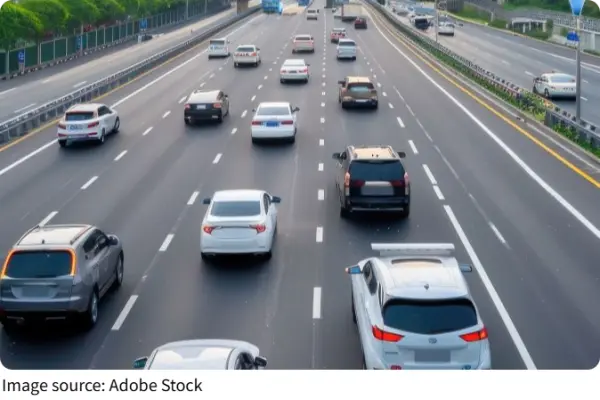
The problem is more complicated when several vehicles travel together as a formation. Each vehicle must maintain an appropriate distance from the vehicle ahead while responding to changes in the surrounding traffic environment. A decision made by one vehicle can therefore affect the stability and movement of the entire group.
Building a Safer Formation Strategy
The study first developed a risk-aware strategy for situations where parts of the intersection cannot be observed directly. Instead of relying only on immediately available sensor information, the approach considers potential hazards in areas that remain hidden.
This risk assessment provides preliminary guidance for vehicle speed and acceleration. The purpose is not simply to make vehicles slower, but to help them select movements that balance safety with efficient travel.
Formation spacing is another important part of the system. Vehicles traveling together need to remain coordinated without creating unnecessarily large gaps. The researchers therefore incorporated spacing control into the broader intersection strategy, allowing the formation to respond collectively as conditions change.
How Reinforcement Learning Helps
Reinforcement learning is a type of artificial intelligence in which a system learns through repeated interaction with an environment. Instead of receiving a fixed instruction for every possible situation, the model evaluates different actions and gradually learns which decisions produce better results.
In this research, reinforcement learning was used to optimize the formation's driving decisions at uncontrolled intersections. The system learned how to adjust variables such as speed and acceleration while considering safety and traffic efficiency. This approach is particularly useful for situations that are difficult to describe with simple rules.
GANs Create More Varied Scenarios
Training an artificial-intelligence system requires exposure to a wide range of situations. A limited set of simulated conditions may not adequately test how a driving strategy responds to unexpected changes. The researchers addressed this issue by introducing generative adversarial networks. GANs can generate additional variations of existing data or scenarios, allowing the testing environment to become more diverse.
For the proposed system, GAN-based scenario generation was used to introduce additional complexity into intersection simulations. This helped the researchers evaluate whether the reinforcement-learning strategy could remain effective when conditions changed rather than simply performing well in a small number of predefined situations.
Testing the Approach in Simulation
The researchers tested the proposed framework through computer simulations using the Simulation of Urban MObility, commonly known as SUMO. The environment represented two nearby uncontrolled intersections where visibility could be restricted by roadside obstacles such as trees.
Additional traffic participants were introduced to create changing conditions around the vehicle formation. The simulations allowed the researchers to examine how the formation responded to potential conflicts and whether vehicles could maintain coordinated movement while adapting their speed and spacing.
Why This Matters for Automated Driving
The research highlights an important issue for future connected and automated transportation. Safe driving cannot depend entirely on clear visibility or predictable traffic behavior. Vehicles may encounter situations where important information is temporarily unavailable, especially around intersections with visual obstructions.
Rather than relying on one fixed response, the proposed framework allows vehicle formations to adjust speed, acceleration and spacing according to changing conditions. Simulation results suggest that this combination can improve formation stability at difficult intersections.