Why Flowers Bloom at Night

Amit Sharma
| 02-11-2026
 · Plant Team
While most familiar flowers open during daylight, some reveal their blossoms only after sunset. These night-blooming plants follow biological rhythms that coordinate their flowering with changes in light, temperature, and other environmental conditions.
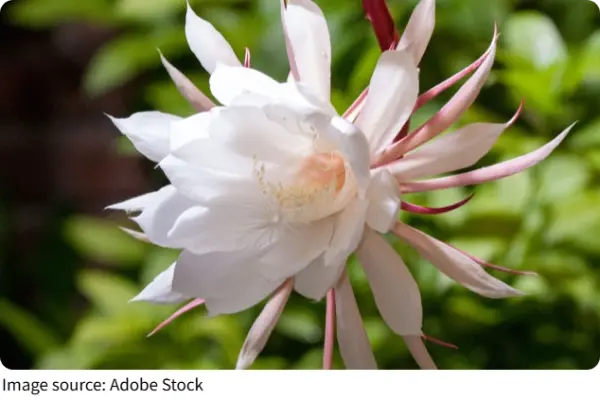
One celebrated example is the Queen of the Night, a tropical cactus whose spectacular white flowers typically open after dusk and last for just one night. Its brief display illustrates how flowering schedules can be closely connected to reproduction and the natural rhythms of pollinators.
The Science Behind Night Blooming
Flowering at night is an adaptation influenced by a plant's internal biological clock and environmental signals. Many plants possess circadian rhythms that help regulate processes such as flower opening, fragrance production, and nectar availability.
Want a garden full of color? Hydrangeas bring beautiful blooms, soft textures, and charm outdoors
Want fuller blooms? Get simple pruning tips for baby's breath to keep plants neat and flowering
Learn to turn simple stones into a beautiful garden
How Africa's Amazing Baobab Trees Store Water, Feed Wildlife, and Help People Survive Long Dry Seasons Each Year
Want fuller blooms? Learn how to grow chrysanthemums in containers for a colorful garden display!
Want gorgeous blue blooms? Learn how to adjust soil conditions and turn pink hydrangeas blue!
For some species, these rhythms synchronize flowering with the activity of animals that are most active after sunset. Rather than attracting daytime bees and butterflies, night-blooming flowers may rely on moths, bats, or other nocturnal visitors to transfer pollen.
This timing can increase the likelihood of successful pollination by making flowers accessible when their primary pollinators are foraging.
However, not every night-blooming plant follows exactly the same schedule. Some flowers remain open into the morning, while others close or wilt after a single night.
The Queen of the Night
Among the most famous night-blooming plants is the Queen of the Night, scientifically known as Epiphyllum oxypetalum. This tropical cactus is native to parts of Mexico and Central America and is widely cultivated for its extraordinary flowers.
Unlike the familiar desert cacti, it is an epiphytic cactus that naturally grows on trees and other supports in humid environments. Its large, fragrant white flowers can reach approximately 20 to 30 centimeters across.
The blossoms generally begin to open in the evening, reach their fullest display at night, and wilt by the following morning. Individual flowers last only a single night, although a healthy plant may produce several flowering episodes during a growing season.
The plant's dramatic appearance and brief flowering period have made it a favorite among gardeners, who sometimes stay awake specifically to witness its blossoms opening.
Its nighttime fragrance and conspicuous flowers are consistent with adaptations for nocturnal pollination, although the identity and importance of specific pollinators can vary by location.
Why Night Flowers Are Often White
Many night-blooming flowers have white, cream, or pale-colored petals. These lighter surfaces can be easier to distinguish under moonlight or other low-light conditions than darker flowers.
The Queen of the Night provides a striking example, producing large white blossoms that stand out against its green stems.
Pale coloring is especially common among flowers associated with moth pollination, although it is not a universal characteristic of nocturnal plants.
Flower shape also matters. Some moth-pollinated flowers have long floral tubes suited to insects with extended feeding structures, while flowers visited by bats may be broader and more accessible.
Together, color, size, and shape help influence which animals can locate and use a flower.
Fragrance as a Nighttime Signal
When daylight fades, scent can become an especially important means of attracting pollinators.
Many night-blooming flowers release strong fragrances during the evening, often producing mixtures of volatile compounds that disperse through the surrounding air.
Moths possess highly sensitive chemical receptors on their antennae, allowing them to detect floral odors and follow scent trails toward nectar sources.
The Queen of the Night is particularly well known for its powerful, sweet fragrance, which becomes noticeable as its flowers open.
Fragrance production can also follow a daily rhythm, allowing plants to concentrate their chemical signals during periods when suitable pollinators are active.
Not all night-blooming flowers are strongly scented, however. Different species rely on different combinations of visual, chemical, and structural signals.
The Role of Moths and Bats
Nocturnal pollinators play an important role in the reproduction of many flowering plants.
Moths visit blossoms to feed on nectar. As they move between flowers, pollen may attach to their bodies and be transferred to another flower of the same species.
Some plants have evolved close relationships with particular groups of moths, including hawkmoths, whose long feeding structures allow them to reach nectar inside deep flowers.
Bats are also important pollinators in tropical and desert ecosystems. Nectar-feeding bats may visit large, sturdy flowers that provide accessible nectar and pollen.
Certain cacti, agaves, and tropical trees depend partly or heavily on bat pollination. By traveling between plants, bats can transport pollen over considerable distances.
These relationships illustrate how flower structure, nectar production, scent, and opening times can evolve in response to the behavior of animal visitors.
Why Nighttime Conditions Matter
Pollination is not the only factor influencing nocturnal flowering. Temperature, humidity, and water availability can also affect the timing and duration of a blossom's opening.
In some environments, cooler nighttime conditions may reduce heat stress and water loss compared with the hottest hours of the day. However, the importance of these advantages varies between species.
The timing of flower opening is controlled through interactions between internal physiological processes and environmental signals, particularly light and temperature.
Artificial lighting can disrupt some nocturnal pollination relationships by changing the behavior of moths and other animals. Research has shown that nighttime illumination can reduce flower visits by certain nocturnal insects, potentially affecting plant reproduction.
These findings highlight the ecological importance of natural darkness. For night-blooming plants, the hours after sunset are not simply a period of rest but an essential part of their reproductive environment.

Night-blooming flowers reveal how closely plant reproduction can be synchronized with the natural world. Their opening schedules, pale petals, fragrances, and specialized structures often reflect relationships with nocturnal pollinators. Behind that remarkable flower lies a sophisticated interaction between biological timing, environmental conditions, and evolution.